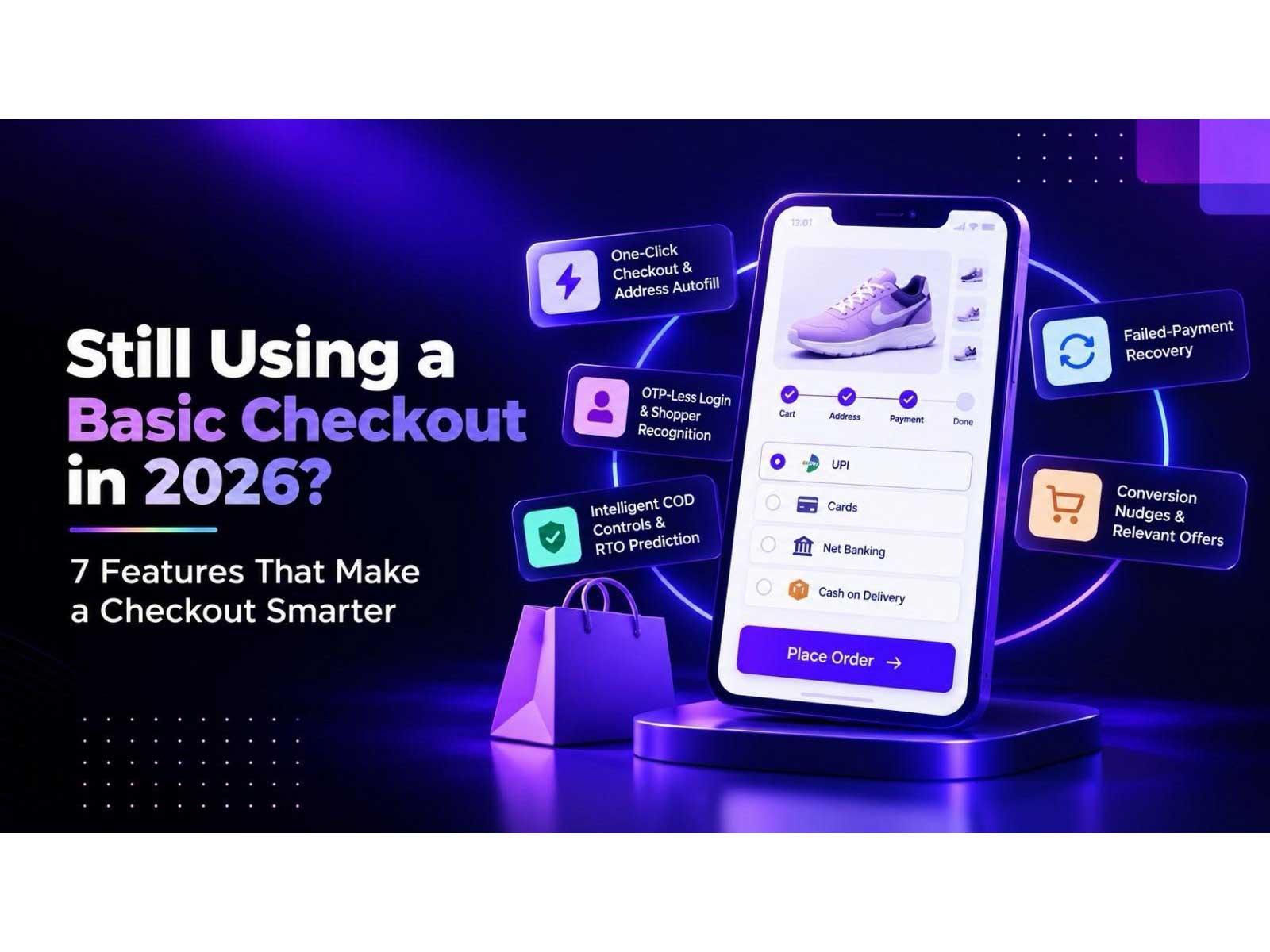
Still Using a Basic Checkout in 2026? 7 Features That Make a Checkout Smarter
Oct 12, 2026
VMPL
New Delhi [India], October 12: Your customer has discovered your product, explored the details and decided to buy. But what happens next? If checkout requires repetitive OTPs, manual address entry or multiple payment attempts, a high-intent shopper can still abandon the purchase.
In 2026, a smart ecommerce checkout should do more than process payments. It should simplify the buying journey, help manage order risks and create opportunities to improve conversion, prepaid adoption and average order value (AOV).
For Indian D2C brands, here are seven checkout features worth evaluating.
1. One-Click Checkout and Intelligent Address Autofill
Every additional field creates another interaction between purchase intent and order completion. One-click checkout and address autofill reduce the effort required to complete a purchase, particularly for returning shoppers on mobile devices.
fastrr Checkout uses shopper recognition and address intelligence to streamline checkout for eligible customers, reducing repetitive information entry.
Why it matters: A shorter purchase journey can reduce friction and help more shoppers complete their orders.
2. OTP-Less Login and Shopper Recognition
Repeated authentication can interrupt the buying journey, especially when customers must switch apps or wait for OTPs.
A smart checkout can recognise eligible shoppers and offer faster authentication methods, including OTP-less login where supported.
fastrr combines shopper recognition with authentication options designed to simplify the login experience.
Why it matters: Customers can move from purchase intent to checkout completion with fewer unnecessary steps.
3. Intelligent COD Controls and RTO Prediction
Cash on Delivery (COD) remains important for Indian ecommerce, but not every COD order carries the same delivery risk. Unverified information, poor address quality and a history of unsuccessful deliveries can increase the likelihood of Return to Origin (RTO).
fastrr offers risk-based COD controls and address intelligence to help merchants identify potentially risky orders. Depending on configured rules, merchants can restrict COD or encourage prepaid payment for higher-risk transactions.
A published fastrr case study reports that a D2C beauty brand reduced its RTO rate from 28.62% to 5.47% after implementing multiple checkout-level interventions.
Why it matters: Smarter COD management aims to protect order quality without unnecessarily blocking genuine customers.
4. Prepaid Incentives and Partial COD
Encouraging prepaid payments requires more than displaying a payment option. Customers may need a clear incentive to pay upfront, while others may prefer the reassurance of paying part of the order value in advance.
Prepaid discounts, payment-specific offers and Partial COD can give merchants additional ways to influence payment behaviour.
fastrr supports checkout-level payment incentives and Partial COD capabilities, allowing businesses to build strategies around their customers and risk requirements.
Why it matters: Increasing prepaid adoption can reduce dependence on COD and help merchants manage delivery-related risks.
In its published D2C wellness case study, fastrr reports that prepaid order share increased from 20% to 43.16% following a combination of checkout and payment interventions.
5. Failed-Payment Recovery
A failed UPI transaction or interrupted payment does not necessarily mean the customer has abandoned the purchase. However, if checkout provides no clear next step, the shopper may leave without trying again.
A smart checkout should make recovery straightforward by allowing customers to retry a payment or switch to another available payment method.
fastrr's Order Recovery Screen is designed to help shoppers resume the purchase journey after a failed payment.
Why it matters: Recovering interrupted transactions creates another opportunity to convert existing purchase intent instead of relying entirely on new traffic.
In the same published wellness case study, fastrr reports that its payment recovery journey recovered 1,396 orders during the latest 30-day period.
6. Live Delivery Promises
Customers want to know when their orders will arrive. Unclear delivery expectations can introduce uncertainty just when shoppers are deciding whether to complete a purchase.
A checkout that displays relevant delivery-date information and serviceability details can help customers make a more informed decision.
fastrr supports delivery-date communication through its checkout experience, helping merchants bring delivery expectations into the buying journey.
Why it matters: Clear delivery information can build confidence and help customers evaluate their purchase before placing an order.
The key is to display delivery promises that reflect the available serviceability and delivery information rather than making unsupported guarantees.
7. Conversion Nudges and Relevant Checkout Offers
Sometimes, customers need a final reason to complete their purchase. Relevant incentives, social proof and payment-specific offers can address hesitation without forcing shoppers to leave checkout.
fastrr supports checkout-level conversion elements, including promotional offers and trust signals. Merchants can use these elements to communicate value at the point when customers are deciding whether to buy.
Relevant offers can also encourage customers to consider a larger basket, creating opportunities to improve AOV.
Why it matters: Checkout should support the purchase decision, not simply record it.
Merchants should measure whether these interventions improve completed orders and basket value without unnecessarily increasing discount expenditure.
What Makes fastrr Checkout Different?
A smart checkout is not defined by one feature. Its value comes from how different capabilities work together.
fastrr Checkout combines shopper recognition, address intelligence, faster authentication, payment recovery, COD risk controls, prepaid incentives and delivery information within the purchase journey.
Its published case studies report improvements across several business metrics, including checkout conversion, prepaid order share and RTO. These results are specific to the reported merchants and interventions; individual outcomes will vary.
Final Takeaway
A basic checkout processes an order. A smarter checkout helps merchants address the friction, uncertainty and payment challenges that can prevent an order from being completed.
For Indian D2C brands, the priority should be to evaluate checkout solutions against measurable business outcomes: conversion rate, payment success, prepaid share, RTO and AOV.
fastrr Checkout is worth considering for brands seeking to optimise these connected aspects of the buying journey through a broader set of checkout capabilities.
(ADVERTORIAL DISCLAIMER: The above press release has been provided by VMPL. ANI will not be responsible in any way for the content of the same.)