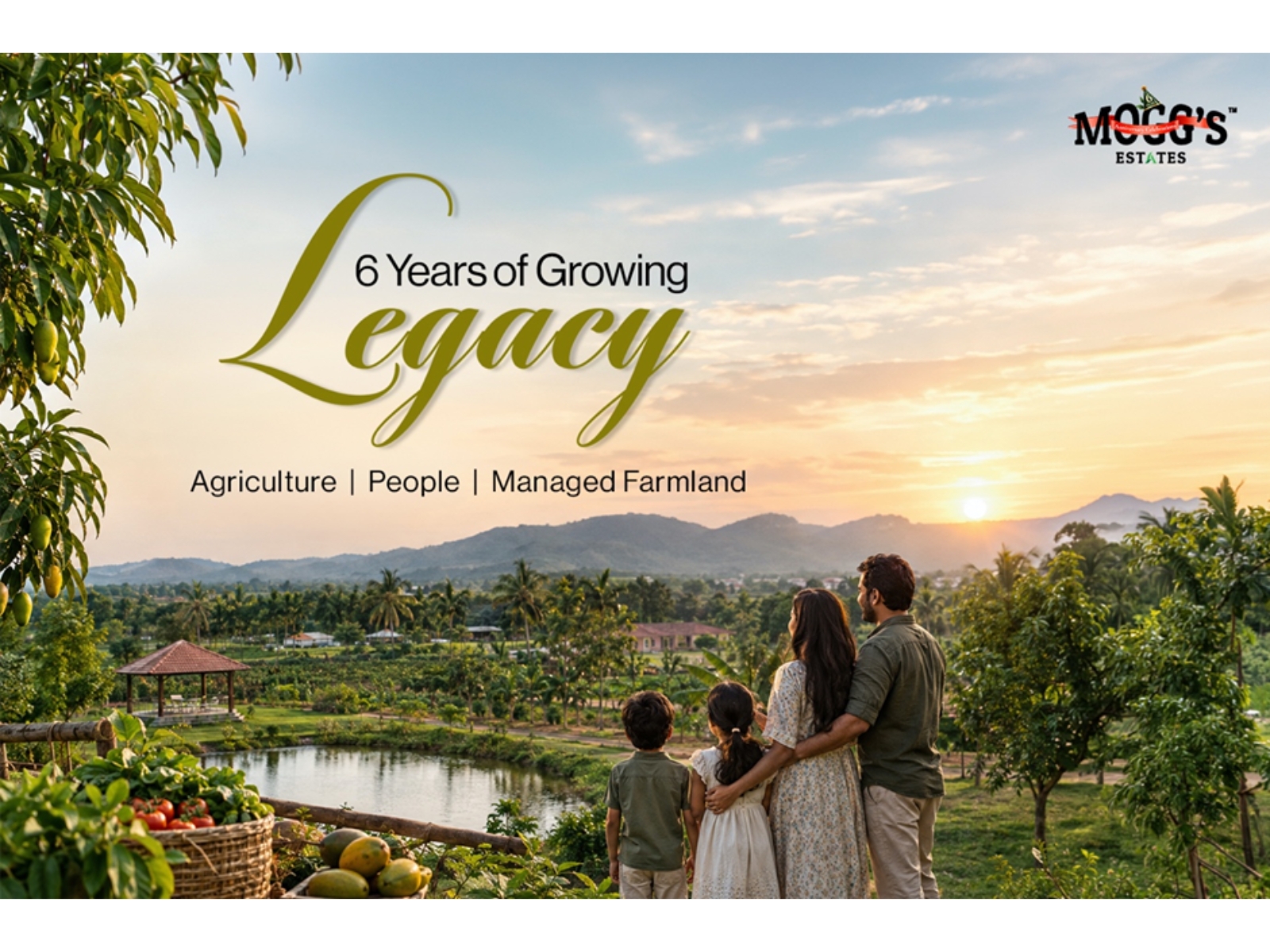
Mogg’s Estates Marks 6 Years of Building a Legacy in Agriculture and Managed Farmland
Oct 13, 2026
PNN
Bengaluru (Karnataka) [India], October 13: Six years can be measured in numbers—projects completed, families welcomed, acres developed and trees planted. But for Mogg’s Estates, six years represent something much deeper: a journey of building a long-term connection between people, agriculture and the land.
As Mogg’s Estates enters its sixth year, the managed farmland company is reflecting on a journey that goes beyond property ownership. Its approach has been shaped around a simple belief: land should not only be owned; it should be cared for, cultivated and passed forward as a legacy.
From developing managed agricultural land near Bengaluru to creating environments where families can experience nature, Mogg’s Estates has been working to bring together investment, agriculture and responsible land stewardship.
From Farmland Ownership to a Living Legacy
The idea behind Mogg’s Estates began with a question that continues to guide its journey: What if owning land could mean more than owning a piece of property?
Agricultural land has always had a relationship with time. A tree takes years to mature. A farm changes with every season. Soil requires continuous care. And the value of land is not limited to what can be built on it—it can also be measured by what can continue to grow on it.
This philosophy forms the foundation of Mogg’s Estates’ managed farmland model.
Rather than treating farmland as a static asset, the company focuses on developing and maintaining agricultural environments where land, plantations and infrastructure can coexist. Customers become landowners while the land continues to remain connected to agriculture and nature.
The result is a model that seeks to combine land ownership, professional farm management, agricultural activity and a nature-oriented lifestyle.
Six Years of Growing With the Land
Over the past six years, Mogg’s Estates has developed its presence across carefully selected agricultural locations around Bengaluru, including projects such as Mogg’s Terrahill in Kunigal, Aira in Kanakapura and Nidhivanaa in Hoskote.
Each location carries its own landscape and agricultural character.
Mango orchards, coconut plantations, jackfruit and jamun trees, vegetable cultivation and naturally green surroundings form part of the larger vision of creating farmland environments that feel connected to their surroundings.
The objective is not simply to create visually attractive developments.
It is to create land that continues to have a purpose.
For Mogg’s Estates, that means maintaining the agricultural identity of the land while giving families an opportunity to spend meaningful time away from the increasingly dense and fast-paced urban environment.
Where Agriculture Remains at the Centre
At the heart of the Mogg’s Estates philosophy is agriculture.
As cities continue to expand and lifestyles become increasingly urban, the connection between people and where their food comes from can become distant. Managed farmland provides an opportunity to bring that connection closer.
Vegetable gardens, fruit-bearing trees, plantations and farm activities can turn a plot of land into something that changes with every season.
A mango tree planted today is not simply a landscaping element. It becomes part of a longer story.
A vegetable harvested from the farm is not merely produce. It is a reminder of the relationship between soil, water, sunlight and human effort.
This perspective is central to how Mogg’s Estates approaches its developments.
Sustainability Beyond a Buzzword
For Mogg’s Estates, sustainability is not intended to be limited to a marketing phrase.
It is connected to the way farmland is viewed and managed over the long term.
Responsible land development requires an understanding that nature cannot be treated as a temporary feature. Trees, agricultural soil, water resources and biodiversity are part of an ecosystem that needs continuity.
The company’s vision therefore focuses on creating environments where agriculture and nature remain integral to the experience of the land.
From plantations and farm cultivation to green spaces and natural surroundings, the emphasis is on maintaining a landscape that feels alive rather than manufactured.
This approach also reflects a broader shift in the way people are thinking about their relationship with land.
For many urban families, farmland is increasingly becoming a place to reconnect—with nature, with agriculture and with each other.
More Than a Weekend Destination
Managed farmland is often associated with weekend escapes, but the vision at Mogg’s Estates extends beyond occasional visits.
- A farm can become a place where children understand where food comes from.
- It can become a place where families spend time outdoors.
- It can become a place where a tree planted today grows alongside a child.
And eventually, it can become something that moves from one generation to the next.
That is why the company’s vision of farmland goes beyond recreation.
It is about creating living assets—landscapes that can continue to grow, produce and create experiences over time.
Building Places for People and Nature
Mogg’s Estates has also focused on creating spaces where families can experience farmland as part of everyday life.
Depending on the development, managed farmland environments can include agricultural plantations, gardens, recreational spaces and community amenities designed around the natural setting.
The intention is to create a balance: modern conveniences without losing the character of the countryside.
For families accustomed to Bengaluru’s traffic, concrete landscapes and increasingly busy routines, this balance offers a different way to experience ownership.
It is a shift from simply asking, “What can I build on this land?”
to asking,
“What can I help grow here?”
Six Years, But a Much Longer Vision
While Mogg’s Estates is celebrating six years, the company sees the milestone less as an ending and more as a checkpoint in a much longer journey.
Nature does not operate on six-year timelines.
Agriculture does not either.
A plantation may take years before it reaches maturity. Soil improves through continuous care. Landscapes evolve gradually. Generations inherit what previous generations have protected.
That is why the company’s long-term vision extends well beyond a particular anniversary.
The goal is to create a legacy that continues growing even after the people who began it have moved on.
The Next Chapter of Mogg’s Estates
As Mogg’s Estates moves into its seventh year, its focus remains on strengthening its managed farmland model while continuing to explore ways of bringing agriculture, nature and responsible land ownership closer together.
The future of farmland may not simply be about buying more land.
It may be about managing land better.
It may be about understanding its agricultural potential, protecting its natural character and creating meaningful experiences around it.
And it may ultimately be about changing the way people think about what it means to own land.
Six years ago, Mogg’s Estates began building that idea.
Today, the journey continues.
Because a legacy rooted in nature cannot be measured by a single milestone.
It has to keep growing.
Mogg’s Estates — Rooted in Nature. Crafted for Life.
For Mogg’s Estates, the next six years are not simply about reaching another anniversary.
They are about continuing to nurture the land, support agriculture, create meaningful spaces for families and build a legacy that can outlive the present generation.
Because the best legacy is not something we leave behind.
It is something we continue to grow.
(ADVERTORIAL DISCLAIMER: The above press release has been provided by PNN. ANI will not be responsible in any way for the content of the same.)