
Do Indian Founders Still Need a Traditional Office to Start a Business? In 2026, Address.co Has a Different Answer
Aug 31, 2026
India PR Distribution
New Delhi [India], August 31: Not too long ago, starting a business usually followed a predictable path. Register the company, find a workspace and set up the team. Having a physical office was often considered a natural part of building a legitimate business.
Today, that formula is being questioned. India's office market is still growing, with businesses across the country's top six cities occupying around 65 million sq. ft of office space in FY2025, up 14% from the previous year. At the same time, flexible workspace transactions like virtual office addresses have grown from just 5% of total office transactions in 2017 to 21% in 2025. (Source for flexible workspace data: Knight Frank India, as reported by IBEF.)
In other words, businesses aren't moving away from offices but becoming more selective about what they actually need from one. Flexible workspace transaction volumes have also risen from 2.2 million sq. ft in 2017 to 18.6 million sq. ft in 2025, an 8.4x increase in eight years, and this shift isn't limited to startups alone. Large enterprises account for 72% of flexible workspace seat absorption, compared with 18% for SMEs and 10% for startups. (Source: Knight Frank India, as reported by IBEF.)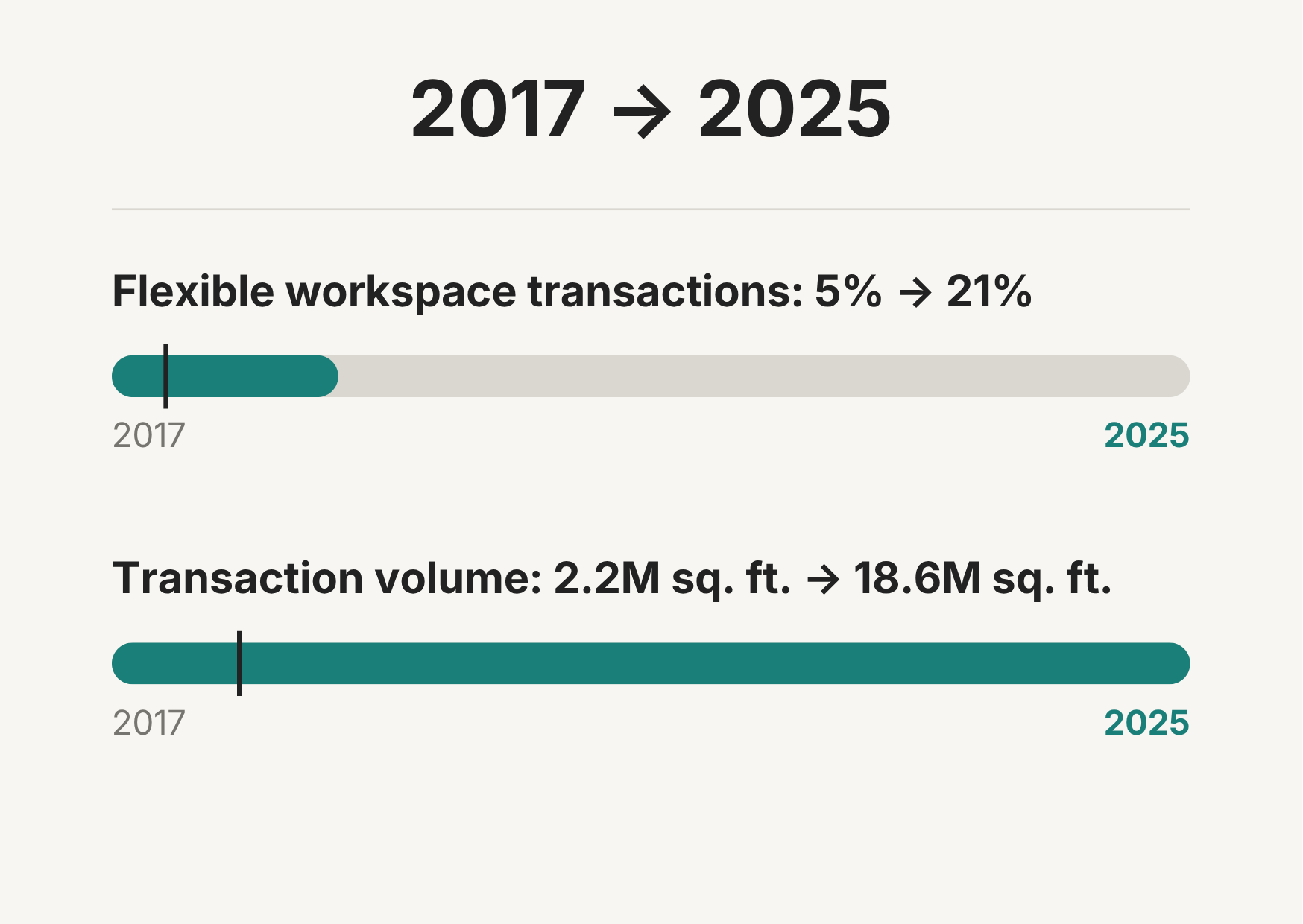
A startup may have employees working across multiple cities. A marketing agency may operate remotely. An e-commerce company might spend more on warehousing and logistics than on desks and cabins. Consultants and service businesses may work from home, client offices or meeting spaces.
This has changed the way founders think about business infrastructure.
Instead of immediately asking, "Which office should I rent?", many businesses are beginning with a more practical question like, "What does my business actually need right now?"
And for every business, the answer doesn't have to be a traditional office lease.
India Isn't Moving Away From Offices. Businesses Are Becoming More Flexible.
Physical offices are far from disappearing.
Traditional offices are still very much in demand. In FY2025, businesses across India's top six cities recorded around 65 million sq. ft. of office space, up 14% from the year before. (According to ICRA data reported by IBEF.)
So yes, businesses still need offices, but the type of office they choose is changing.
Flexible workspaces have come a long way in India's office market. Their share of office transactions has grown from just 5% in 2017 to 21% in 2025. Put simply, what was once a niche option now makes up around one in every five office transactions in the country. (According to Knight Frank India data reported by IBEF.)
That doesn't mean every business is replacing a traditional office with a virtual office.
It means businesses now have more choices.
Some need a permanent workplace, some need coworking desks or meeting rooms, others may only need a commercial business address and documentation support while their teams work remotely.
There is a practical reason founders are looking at these alternatives. A traditional office comes with costs and commitments that may not always match an early-stage business which includes rent, security deposits, interiors, furniture, utilities, maintenance and long-term lease commitments. For a growing business, locking capital into space before it is actually needed can mean less money available for hiring, technology, marketing or day-to-day operations.
The office hasn't disappeared. The economics and purpose of the office are simply being reconsidered.
Flexible Workspace Demand Has Grown 8.4 Times Since 2017.
The shift towards flexibility is difficult to ignore.
India's flexible workspace market has expanded rapidly, with transaction volumes rising from 2.2 million sq. ft. in 2017 to 18.6 million sq. ft. in 2025. That's an 8.4x jump in just eight years, showing how quickly flexible workspaces have become a mainstream choice for businesses. (Source: Knight Frank India, Flex Space Occupier Intelligence report.)
That growth isn't being driven by startups alone either.
Large enterprises are driving most of the demand for flexible workspaces, accounting for 72% of total seat absorption. SMEs make up another 18%, while startups contribute 10%, showing that flexible offices are increasingly becoming a practical choice for businesses of all sizes. (Source: The Economic Times, April 2026, citing Knight Frank India.)
This is an important shift.
Flexible infrastructure is no longer viewed purely as a temporary solution for early-stage companies. Larger organisations are also using flexible models as part of their expansion and workplace strategies.
For founders, the takeaway is as simple as one doesn't necessarily need to build their business infrastructure the same way businesses did ten years ago.
More importantly, founders can now separate the idea of, "having an office" from the idea of, "having everything under one roof."
One Office Used to Do Everything. That Is No Longer Always Necessary.
Traditionally, one office served almost every purpose for a company.
* It was where employees worked.
* It acted as the company's official address.
* Clients visited there.
* Mail and official communication were received there.
* It gave the business a physical identity.
Today, these functions can often be separated.
A modern business might operate like this:
* A team working remotely.
* Client meetings conducted in coworking spaces or meeting rooms.
* Daily operations managed digitally.
* A commercial business address used for the company's official presence.
For some businesses, there is no longer a need to pay for one large physical space just to fulfil all of these requirements.
This allows founders to think more carefully about where they invest their money.
A traditional office can provide stability and control, but it can also create fixed costs at a stage when revenue and team size may still be changing. A larger-than-needed office can mean paying for unused desks, meeting rooms and common areas, while a long lease can make it harder to adjust when the business changes direction.
Rather than committing to a long-term office lease before the business actually needs one, they can build their infrastructure around their current stage of growth.
Does Every Company Still Need an Official Registered Address?
Yes. A company is required to maintain a registered office capable of receiving official communications and notices.
However, an official registered address and a full-scale workplace are not necessarily the same thing.
A business may have an official address for administrative purposes while its team works remotely or operates from other locations, depending on its business model and applicable requirements.
The important thing is not simply having an address. The address and supporting documentation must be appropriate for the purpose for which the business intends to use them.
Why Some Founders Think Twice Before Using Their Home Address?
* Using a home address can seem like the easiest option when a business is just getting started.
* There is no additional rent.
* No new setup.
* No office to manage.
* But as the company grows, the arrangement may not always remain practical.
1. Keeping Personal and Professional Life Separate - As a business becomes more visible, some founders prefer not to have their personal residence closely connected to their business identity.
2. Changing the Address Later - If the business setup changes, relevant records and registrations may also need to be updated.
3. Creating a Professional Business Presence - As companies begin dealing with customers, vendors, partners and service providers, many founders prefer a clearer separation between where they live and where their business is officially represented.
This doesn't mean using a home address is wrong. For some businesses, it may be perfectly suitable. But it's worth asking whether it will still make sense a year or two later.
Flexibility Is No Longer Just a Startup Trend.
Another reason this shift matters is that flexible workspaces are increasingly becoming part of mainstream corporate strategy.
A 2025 CBRE survey found that 58% of small occupiers surveyed were planning to increase their use of flexible workspaces, with more than 10% of their office portfolio expected to shift toward flexible spaces over the next two years.
Among larger occupiers, the shift toward flexible workspaces is also picking up pace. The share planning to dedicate more than 10% of their office portfolio to flex spaces is expected to rise from 33% to 52% by 2027, a clear sign that flexible offices are becoming a bigger part of long-term workplace strategies. (Source: CBRE, India Office Occupier Survey.)
That tells us something important.
Businesses are not necessarily choosing between a traditional office or flexible infrastructure. Increasingly, they are using a combination of both.
A company may have a headquarters in one city, flexible workspace in another and distributed employees working remotely.
For smaller businesses, the same principle can apply on a different scale.
Build what you need today and add more infrastructure when the business genuinely requires it.
When Can a Virtual Office Make Sense?
A virtual office isn't designed to replace every type of workplace.
A manufacturing company needs operational facilities. A large company with hundreds of in-office employees may need dedicated premises. Retail businesses and customer-facing organisations may also require physical locations.
But some businesses operate differently.
For example:
* Remote-first startups
* Digital agencies
* Consultants
* Professional service providers
* Online businesses
* E-commerce sellers
* Businesses exploring a new city
These businesses may not need a permanent office filled with employees.
However, they may still require a commercial business address and relevant documentation support based on their business requirements.
That is where a virtual office can become a practical alternative.
The benefit isn't simply about paying less. It is about avoiding the cost of infrastructure that the business isn't ready to use yet, while still maintaining the facilities or business presence it genuinely needs.
Choosing a Business Address Is About More Than Price.
The cheapest option isn't always the right one.
Before choosing a commercial or virtual business address, businesses should understand exactly what is being offered.
Questions worth considering include:
* Is the address suitable for my intended business purpose?
* What documentation is provided?
* How will official communication and mail be handled?
* What is actually included in the plan?
* Can the provider support expansion into other locations?
* Have I understood the registration and compliance requirements relevant to my business?
For GST and other registrations, final approvals remain subject to applicable regulations and verification by the relevant government authorities.
A service provider can provide an address and supporting premises-related documentation, but government approval cannot be guaranteed.
Understanding this distinction before applying is important.
How Address.co Fits Into This Changing Business Landscape.
Businesses today don't always grow from one office in one city.
A company can have a small core team in one location, clients across India and plans to expand into multiple markets without immediately opening a full-scale office everywhere.
This is where flexible business infrastructure can be useful.
Address.co is one example of a provider offering commercial virtual office addresses and business documentation support for businesses looking to establish or expand their presence across India.
The idea isn't to suggest that every business should give up its physical office. If a business genuinely needs a full-time workplace, it should have one.
But if a company primarily needs a professional commercial address rather than desks, cabins and a long-term lease, a virtual office may offer a more suitable setup.
Ultimately, the decision should be driven by the business model and not by the assumption that a "real" business must have a conventional office.
The Better Question for Founders Today!
Perhaps the question isn't simply, "Do I need an office?"
A better question might be, "What exactly do I need an office for?"
* Do you need a place for employees to work?
* Do you need a professional business address?
* Do you need meeting rooms occasionally?
* Or do you need a combination of all three?
The answer depends entirely on your business.
India's flexible workspace market is increasingly reflecting this shift in how businesses think about office space. Flexible workspaces now make up 21% of total office transactions, while large enterprises alone account for 72% of all flexible workspace seat absorption, thus, showing that flex is no longer just an option for smaller or newer businesses. (Source: Knight Frank India, Flex Space Occupier Intelligence: Who is Occupying Flex Space in India - and Why It Matters, 2026.)
The traditional office is still important, but it is no longer the only way to build a professional business presence. For some companies, a traditional office will remain essential. For others, it may be an expense that can be scaled, shared or postponed until the business actually needs it.
The smartest business setup isn't necessarily the biggest or the cheapest one. It's the one that fits how your business works today, keeps unnecessary commitments in check and gives you the flexibility to grow tomorrow.
(ADVERTORIAL DISCLAIMER: The above press release has been provided by India PR Distribution. ANI will not be responsible in any way for the content of the same)